
The industry default step length for rod pump simulation is 50 feet. In a 6,000-ft deviated well, that gives you 120 calculation points. A tight dogleg at 3,200 ft that spans 35 feet can fall entirely between two of those points. The solver doesn't see it. Your side load calculation misses the peak. Your rod guide goes in the wrong place.
This isn't a rounding error. It's a structural blind spot in the model, and it's the reason wells with "good" simulation results still fail at the same depth every six months.
What step length actually controls
The wave equation solver discretizes the rod string into elements at fixed intervals along measured depth. At each node, it computes axial load, lateral displacement, rod-tubing clearance, and contact force based on the interpolated wellbore trajectory at that point. Step length determines how many of these nodes exist - and therefore how much of the wellbore geometry the solver actually sees.
Between nodes, the solver assumes a smooth path. If the real wellbore has a 3 deg/100ft kick in a 35-ft section and both bounding nodes land outside that section, the kick doesn't exist in the model. The solver propagates wave reflections, computes friction, and resolves contact forces along a trajectory that's straighter than the one you drilled. Every downstream calculation inherits that error.
The dogleg problem
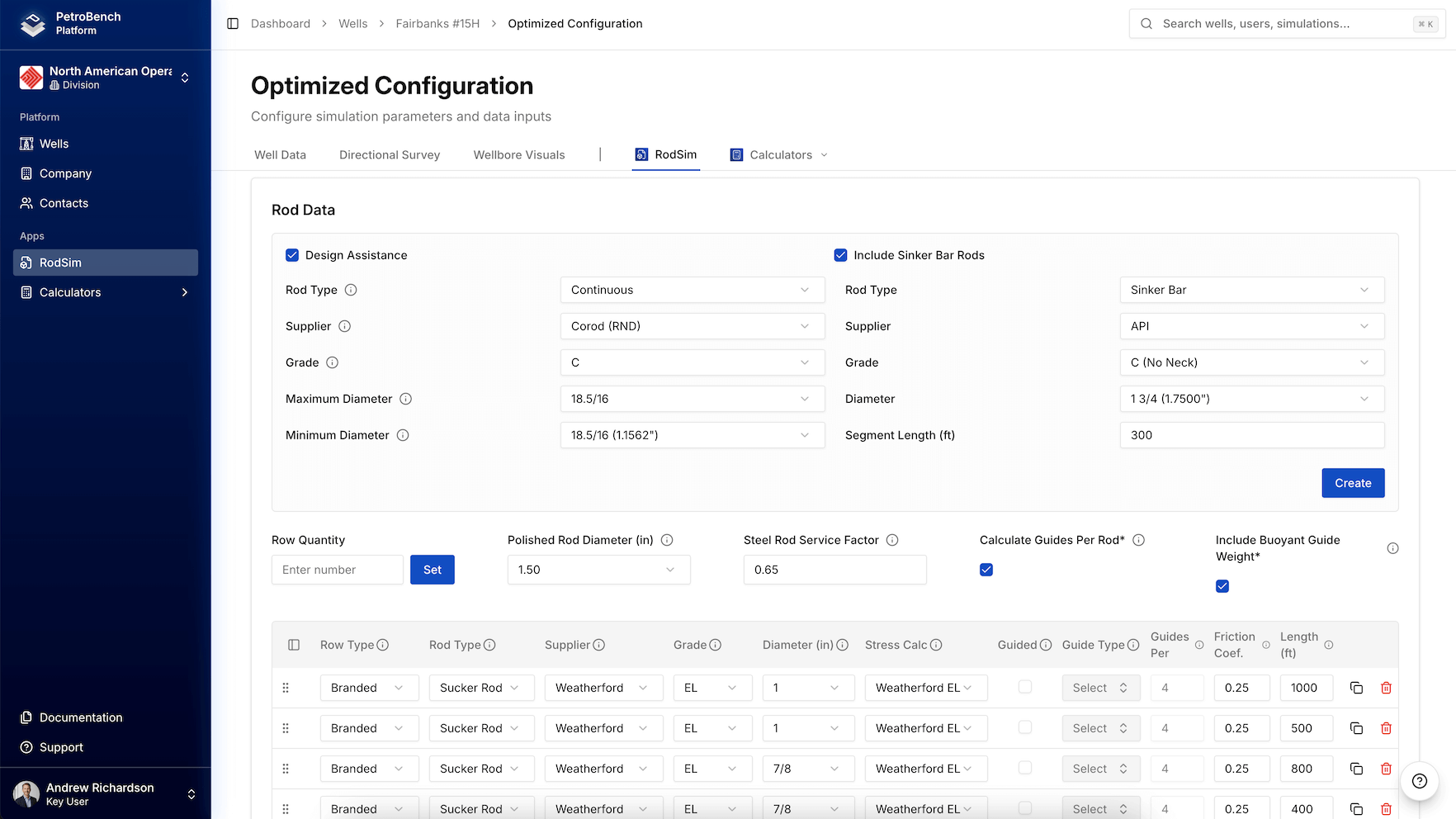
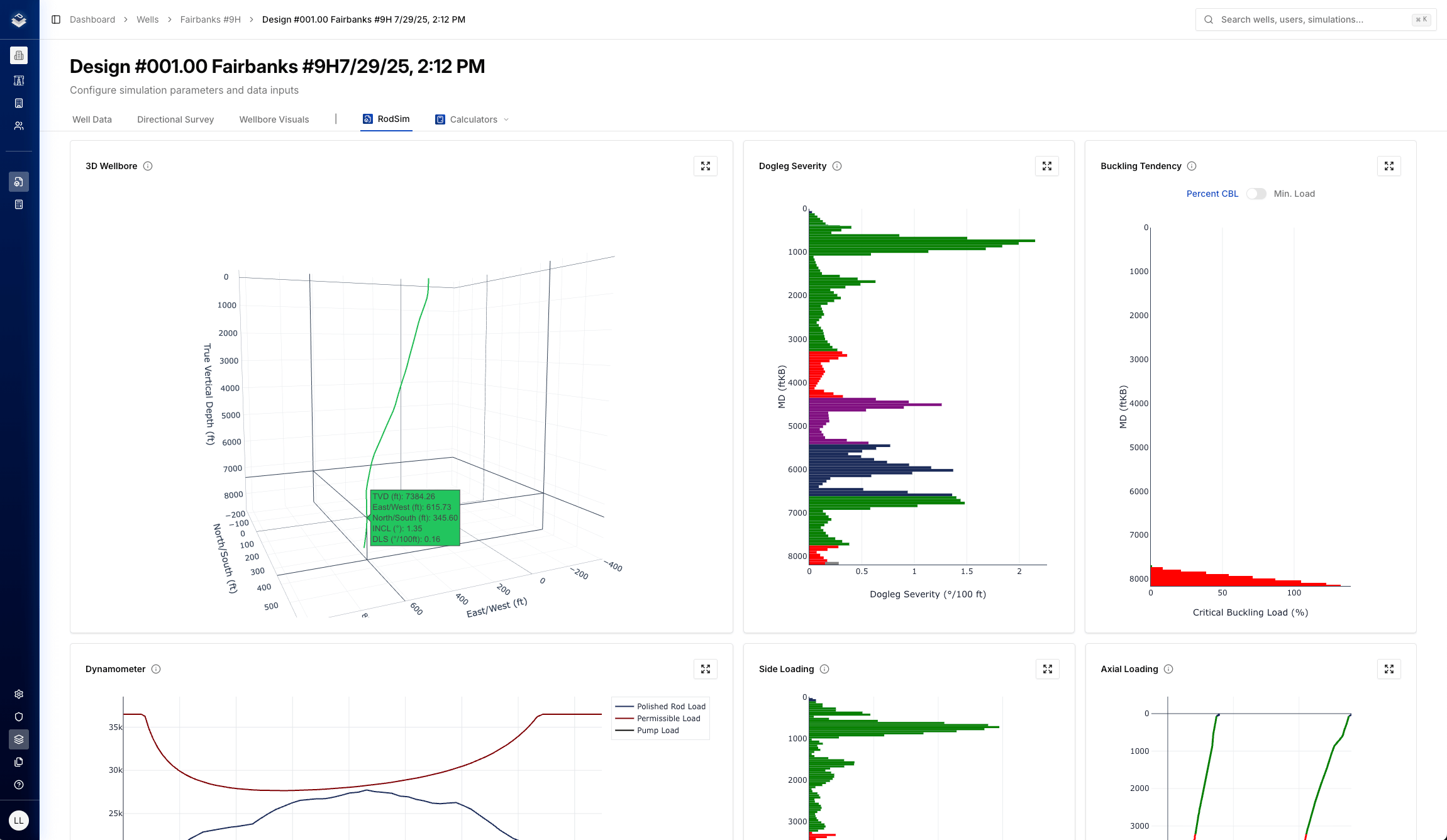
Take a well with a build section from 2,800 to 3,400 ft, average inclination building from 15 to 45 degrees. Survey data shows a localized dogleg of 3 deg/100ft over a 40-ft section centered at 3,180 ft - the kind of thing you get drilling through interbedded shale and limestone where the bit walks. That 40-ft section generates a side load peak that can exceed 200 lbs on 7/8-in Grade D rods running at 8 SPM with a 168-in stroke.
At 50-ft steps, the two nearest nodes might land at 3,150 ft and 3,200 ft. The solver interpolates a gentle curve between them. The peak 200+ lb side load gets smeared across two elements and reports as roughly 80 lbs - well below the threshold where anyone would install a rod guide. At 10-ft steps, you get four or five nodes through that same section. The side load profile resolves into a clear spike at 3,180 ft. The 200-lb peak shows up. The guide recommendation changes.
This isn't hypothetical. We see it constantly in support conversations. An engineer runs a well at default resolution, gets a clean side load profile, installs no guides, and pulls a worn rod at 3,180 ft eight months later. They re-run at 10-ft steps and the contact point was there all along - the model just couldn't see it.
What you miss at 50-ft steps
Rod-tubing contact points. Every dogleg creates a potential contact zone. At coarse resolution, short-interval contacts vanish from the model entirely. The simulation says the rod is centered at 3,180 ft. The wear pattern on the pulled rod says otherwise. You can't place guides correctly if your model doesn't show you where contact occurs.
Guide placement accuracy. Rod guide spacing is derived from simulation output. If the model averages a contact point from 3,180 ft to somewhere between 3,150 and 3,200, the guide lands 20-30 ft from the actual contact zone. That's enough to leave the high-wear section unprotected. The well fails at the gap.
Buckling onset zones. During the downstroke, the lower rod string transitions from tension to compression. Where that transition occurs depends on local wellbore curvature, rod weight, and fluid load. In a deviated well with irregular doglegs, coarse resolution can shift the predicted buckling onset by 50-100 ft from where it actually initiates. You end up with sinker bars or heavier rod sections positioned based on a geometry the well doesn't have.
Side load magnitude. This is the one that costs the most. A 200-lb side load at a specific depth is an actionable data point - it tells you where to put a guide, what guide material to use, and whether the rod grade can handle the combined axial and lateral stress. An 80-lb averaged load across 50 ft tells you nothing useful. It's noise masquerading as data.
When 50-ft steps are fine
Vertical wells with max inclination under 5 degrees and DLS consistently below 1 deg/100ft. The wellbore is close enough to a straight line that coarse discretization doesn't lose meaningful geometry. Smooth, constant-rate build sections with DLS of 1-2 deg/100ft and no abrupt changes also fall into this category - there are no localized features for the solver to miss.
Sparse survey data is the other case. If your surveys are at 200-ft stations, a 10-ft step length is interpolating between points that are already far apart. The survey is the resolution bottleneck, not the solver. You'd need gyro or continuous surveys to justify finer steps in that scenario.
When you need finer resolution
Any well with DLS exceeding 2 deg/100ft at any point in the survey. That's the threshold where the difference between 50-ft and 10-ft resolution starts changing the answer, not just the precision. If you've got a 4 deg/100ft kick in a 30-ft section, 50-ft steps literally cannot resolve it.
Repeat failure wells are the strongest case. If a well keeps failing at the same depth and the simulation doesn't show anything unusual at that depth, the first thing to check is step length. We've seen engineers spend months troubleshooting rod grade, pump spacing, and operating parameters when the root cause was a dogleg the model never resolved.
Horizontal wells with build sections need it by default. The build from vertical to horizontal concentrates the highest curvature, the highest side loads, and the highest wear rates into a relatively short interval. Running that section at 50-ft resolution is choosing not to see the forces that drive most of your failures.
Wells with known micro-doglegs from MWD or gyro data - anything showing short-interval severity spikes in the survey - should always run at the finest resolution the survey supports. The data is there. Let the solver use it.
If your simulation can't explain your failures, it's probably not seeing your wellbore.